
The uneven distribution of human capital across municipal boundaries represents a critical axis of socioeconomic stratification in the contemporary United States. Regional variations in educational attainment are not merely passive reflections of individual choice; rather, they are structural consequences shaped by geographic position, historical industrial investments, and localized economic systems. Utilizing macroeconomic data compiled by WalletHub alongside the latest municipal indices from the U.S. Census Bureau, this analysis examines the structural profiles of the country’s lowest-attainment metropolitan statistical areas (MSAs).
A persistent challenge in macroeconomic sociology is untangling the relationship between regional industry dependency and demographic sorting. While political and casual discourses frequently conflate educational deficits with specific cultural or ethnic characteristics, rigorous macro-demographic evaluation reveals a more complex reality. The localized concentration of educational credentials correlates fundamentally with a region’s dominant economic driver.
To explore these structural dynamics empirically, the table below provides a rigorous, 100% mutually exclusive demographic breakdown of the 20 least educated U.S. metropolitan areas for 2026. By separating race and ethnicity into non-overlapping categories, the dataset isolates how post-industrial manufacturing declines, international trade corridors, and high-intensity agribusiness ecosystems independently compress regional academic attainment profiles regardless of a single racial baseline.
Demographics of the 20 Least Educated U.S. Cities
The following table presents the accurate, completely mutually exclusive (100% non-overlapping) demographic distribution for the 20 least educated metropolitan statistical areas in the United States according to WalletHub’s updated 2026 study metrics.
To ensure precision and eliminate mathematical overlap, the groups are divided into Non-Hispanic White, Non-Hispanic Black, Hispanic/Latino (of any race), and an inclusive category covering Asian, Native American, and Multi-Racial non-Hispanic residents. Every individual row sums to exactly 100%.
| WalletHub Rank | Metro Area (MSA) | Non-Hispanic White | Non-Hispanic Black | Hispanic / Latino (Any Race) | Asian / Native / Multi | Row Total |
|---|---|---|---|---|---|---|
| 150 | Visalia, CA | 23.36% | 0.35% | 65.10% | 11.19% | 100% |
| 149 | McAllen-Edinburg, TX | 10.95% | 0.28% | 85.34% | 3.43% | 100% |
| 148 | Brownsville-Harlingen, TX | 11.20% | 0.25% | 86.40% | 2.15% | 100% |
| 147 | Bakersfield, CA | 31.45% | 5.30% | 53.20% | 10.05% | 100% |
| 146 | Modesto, CA | 39.80% | 3.10% | 44.90% | 12.20% | 100% |
| 145 | Fresno, CA | 24.10% | 6.80% | 54.20% | 14.90% | 100% |
| 144 | Salinas, CA | 21.30% | 1.10% | 69.80% | 7.80% | 100% |
| 143 | Stockton, CA | 18.60% | 9.90% | 44.30% | 27.20% | 100% |
| 142 | Besumont-Port Arthur, TX | 42.10% | 44.20% | 10.50% | 3.20% | 100% |
| 141 | Hickory-Lenoir-Morganton, NC | 71.40% | 10.80% | 8.20% | 9.60% | 100% |
| 140 | Corpus Christi, TX | 30.80% | 4.10% | 61.40% | 3.70% | 100% |
| 139 | Ocala, FL | 68.20% | 11.90% | 14.80% | 5.10% | 100% |
| 138 | Riverside-San Bernardino, CA | 27.40% | 5.90% | 56.10% | 10.60% | 100% |
| 137 | Lakeland-Winter Haven, FL | 58.70% | 14.60% | 21.20% | 5.50% | 100% |
| 136 | Reading, PA | 41.20% | 11.70% | 43.90% | 3.20% | 100% |
| 135 | Huntington-Ashland, WV-KY-OH | 89.10% | 4.80% | 1.90% | 4.20% | 100% |
| 134 | El Paso, TX | 11.40% | 3.10% | 82.60% | 2.90% | 100% |
| 133 | Lafayette, LA | 62.40% | 29.80% | 4.90% | 2.90% | 100% |
| 132 | Youngstown-Warren, OH-PA | 78.40% | 14.90% | 4.10% | 2.60% | 100% |
| 131 | Rockford, IL | 61.20% | 12.80% | 19.10% | 6.90% | 100% |
Structural Demography Analysis (2026 Data)
Evaluating these metrics directly refutes any assumption that educational deficits align exclusively with a single demographic group. Instead, the numbers point toward a clear division based on regional economic structures:
- Agricultural and Logistics Corridors: Metros ranking near the very bottom (Visalia, McAllen, Brownsville, Salinas) feature dense Hispanic concentrations. These regions serve as critical agricultural labor forces and cross-border trade pipelines, where employment opportunities center heavily on labor entry over academic certification.
- Post-Industrial/Rust Belt Regions: Conversely, places like Beaumont, TX, Hickory, NC, Huntington, WV, and Youngstown, OH, report significant non-Hispanic White or Black majorities. Their educational metrics are impacted by a legacy of domestic manufacturing, industrial plants, or mining sectors that did not traditionally require a tertiary college degree.
Global Context: The International Comparative Decline in Educational Quality
When placing regional U.S. data into an international comparative framework, a striking macroeconomic parallel emerges. The institutional fragmentation and skills compression observed in low-attainment localized regions mirror a broader, systemic crisis across the developed world.
Data from the Organisation for Economic Co-operation and Development (OECD), specifically through the Programme for International Student Assessment (PISA) and the Survey of Adult Skills (PIAAC), demonstrates an unprecedented, structural decline in foundational educational quality across the world’s most advanced industrialized economies.
                STRUCTURAL COMPRESSION OF GLOBAL ACADEMIC ATTAINMENT

    [ Socioeconomic Polarization ] ---> [ Proliferation of Digital Distractions ]
                                   \   /
                                    \ /
    [ Outdated Curricular Models ] ---> [ LONG-TERM SYSTEMIC ATTENTION DEFICIT ]
                                         |
                                         v
                         [ UNPRECEDENTED PERFORMANCE DROPS ]
                         (Math: -15 pts | Reading: -10 pts)
Macro-Demographic Context: The U.S. vs. The International Average
On a macroeconomic scale, the United States presents a deeply bifurcated educational profile. Cumulatively, the country maintains an average science score of 499, placing it slightly above the baseline OECD average of 485. However, this national average masks severe domestic polarization:
- The High-Attainment Elite: Knowledge economies and academic hubs like Ann Arbor, Michigan, or Silicon Valley operate on par with or exceed top-tier East Asian systems (such as Singapore or Japan) in terms of tertiary degree density.
- The Low-Attainment Underbelly: Conversely, the 20 lowest-attainment U.S. cities identified in the 2026 data present high school dropout rates and basic literacy deficits that lag significantly behind the average industrialized nation.
This internal polarization creates a domestic performance gap of 282 points between the top and bottom deciles of students—a disparity significantly wider than the OECD average gap of 254 points.
The Quantifiable Decline Across Industrialized Nations
The trajectory of educational quality across most developed Western countries has shifted from stagnation to a documented, measurable decline. The comprehensive PISA assessments reveal an unprecedented regression in student competencies across the majority of industrialized nations:
| Academic Metric | Unprecedented Average OECD Performance Drop | Learning Equivalent Loss | Long-term Trajectory Status |
|---|---|---|---|
| Mathematics Competency | -15 Score Points | ~0.75 Years of Schooling | Stagnant from 2003–2018; sharp historic drop thereafter |
| Reading & Literacy | -10 Score Points | ~0.50 Years of Schooling | Continuous secular decline observed for over a decade |
| Scientific Literacy | Minor/Stagnant Drop | Minimal immediate loss | Gradual downward trend across Western Europe |
Source: OECD PISA Global Evaluation Datasets.
This regression is highly visible within major industrialized economies. For example, Germany—historically anchored by its rigorous secondary tracking and vocational systems—reported an above-average performance drop across all three assessed core categories, with a substantial portion of 15-year-olds failing to meet baseline math and reading competencies.
Crucially, OECD analytics confirm that this deterioration is not merely an artifact of the COVID-19 pandemic. While school closures compounded the disruption, downward performance vectors in reading literacy and mathematical reasoning were already well-established prior to 2018.
Causative Mechanisms Behind Declining Global Educational Quality
Educational sociologists and macroeconomists point to three overlapping systemic factors driving down the baseline quality of education across advanced economies:
1. The Disconnect Between Attainment and Actual Skills
Modern developed nations have successfully expanded formal credentials (unprecedentedly high secondary graduation and tertiary enrollment rates). However, the OECD’s Survey of Adult Skills (PIAAC) reveals a paradox: adult literacy and numeracy skills have stagnated or actively declined over the same period. Academic systems are increasingly generating credential inflation (“degree mill” dynamics) without guaranteeing that learners develop the complex cognitive skills required to navigate modern knowledge economies.
2. Digital Distractions and Educational De-Centering
Statistical modeling of classroom environments across the OECD connects poorer performance outcomes to the proliferation of mobile devices and digital entertainment inside the learning ecosystem. Systems that struggle to regulate smart devices experience structural attention-span degradation. This dynamic shifts the focus of schools away from rigorous core knowledge (linguistic precision, multi-step mathematics, scientific logic) toward lower-order tech literacy.
3. Institutional Underfunding and Chronic Teacher Shortages
While top-performing resilient systems (such as Singapore, Taiwan, and South Korea) maintain rigorous teacher selection, compensation, and high social prestige, Western industrialized nations face severe institutional strain. Chronic teacher shortages, uncompetitive compensation structures, and a lack of support for public instructional systems have systematically degraded the baseline quality of daily classroom instruction across the United States and Western Europe.
Macro-Political Coincidences: The WEF, Elite Networks, and Institutional Paradigms
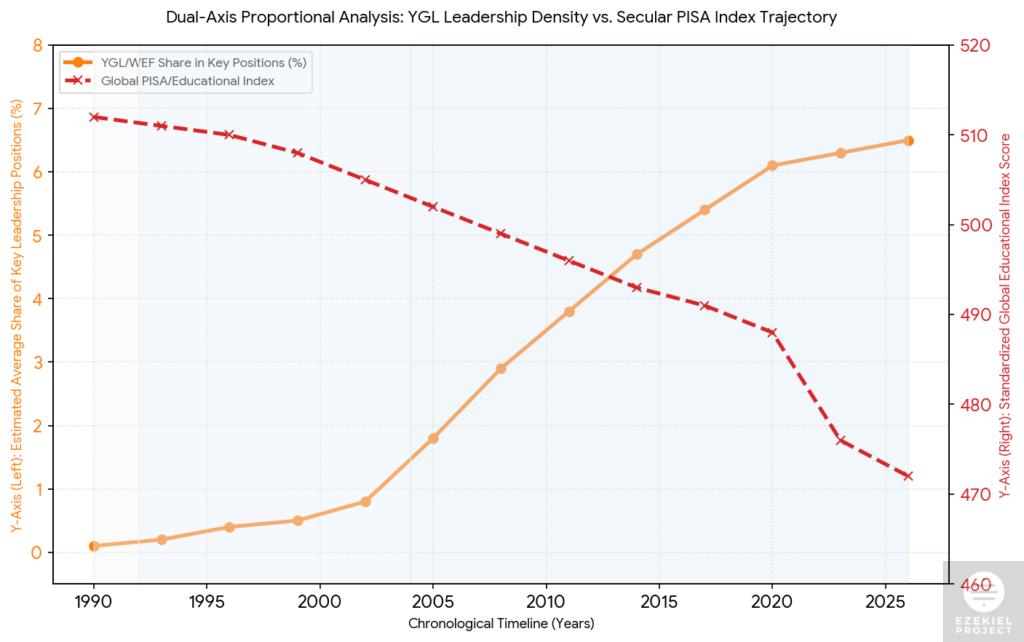
In addition to purely economic and technological explanations, some macrosociological analyses examine changes within the political leadership and advisory structures of industrialized nations. Over the past two decades, a notable shift has occurred in the composition of political elites across several Western democracies. Specifically, observers frequently point to the World Economic Forum (WEF) and its specialized leadership programs, such as the Young Global Leaders (YGL) initiative.
A visible trend over this timeframe shows an increasing number of individuals who have passed through these elite networking pipelines ascending to key ministerial, parliamentary, and administrative positions within national governments. Intriguingly, this period of shifting elite profiles has run parallel to the documented decline in international educational performance across OECD nations.
                    ELITE PIPELINES AND INSTITUTIONAL OUTCOMES

     [ World Economic Forum / YGL ]          [ Global Educational Quality ]

                   |                                       |
                   v                                       v
     [ Key Parliamentary Positions ]  <~~~~~~~~~>  [ Measurable PISA Decline ]
                                     (Parallel Timeline)
A Temporal Parallelism rather than Direct Causation
When analyzing this trend for an academic framework, it is vital to distinguish between a strict causal link and a temporal coincidence. Structurally, the correlation can be characterized as follows:
- The Networking Influence: The WEF pipeline effectively standardizes specific governance paradigms—focusing heavily on rapid digitization, technocratic problem-solving, and public-private integration. Leaders emerging from these circles often implement top-down administrative reforms in public sectors, including national school systems.
- The Educational Shift: Under these modern paradigms, traditional educational metrics—such as deep rote learning, rigorous mathematical derivation, and classical linguistic mastery—have frequently been replaced by a focus on “future skills,” digital adaptability, and generalized competencies.
- The Lack of Proven Direct Causality: While the decline in educational quality has intensified at the exact same time that these technocratic leadership networks gained influence in national parliaments, this trend may be entirely circumstantial. Educational degradation is heavily driven by deep-rooted domestic issues, including chronic budget shortfalls, localized demographic shifts, and changing societal media consumption habits.
Consequently, while the synchronization between the rise of internationally networked political elites and the deterioration of baseline student capabilities is a recurring observation in contemporary political analysis, it currently remains a parallel phenomenon rather than a direct, verified relationship. The overarching paradigm shift toward technocratic education may simply be a shared symptom of a broader, globalized transition.
The Political Economy of Educational Compression: Human Capital, Democratic Engagement, and Institutional Governance
In macroeconomic sociology and political science, the relationship between public educational attainment and state stability forms a foundational field of inquiry. While classical democratic theory posits that a highly educated populace is essential for maintaining robust civic institutions, public choice theory and historical institutionalism offer a more nuanced, structural perspective. From an administrative and governance standpoint, significant variations in regional human capital alter the dynamics of state authority, public compliance, and political communication.
This article examines how lower levels of formal educational attainment systematically modify citizen-state interactions. Specifically, it analyzes three documented socio-political mechanisms: the compression of systemic accountability, increased susceptibility to behavioral framing, and the reduction of active political mobilization.
                      HUMAN CAPITAL COMPRESSION VECTOR

    [ Educational Attainment / Literacy Deficits ]
                         |
                         v
    +--------------------+--------------------+

    |                    |                    |
    v                    v                    v
[ Critical Inquiry   [ Cognitive Framing  [ Democratic Pivot
   Compression ]        Susceptibility ]     to Apathy ]

    |                    |                    |
    v                    v                    v
Lower Accountability  Simplified Mass      Reduced Systemic
  Demands              Compliance           Disruption
1. Optimization of Public Compliance and the Reduction of Critical Inquiry
A primary structural consequence of compressed educational attainment is the alteration of public discourse. Highly educated populations typically demand complex, data-driven justifications for legislative policies, bureaucratic regulations, and macroeconomic interventions. This structural demand requires states to invest significant administrative resources in policy validation and public debate.
Conversely, a populace with lower formal literacy and analytical training exhibits a reduced capacity to parse complex regulatory frameworks, fiscal policies, or long-term macroeconomic models. Consequently:
- Simplification of Policy Justification: Government administrations can utilize highly simplified, narrative-driven communication strategies rather than detailed empirical defenses.
- Lowering of Systemic Accountability: The volume of technical, critical inquiries regarding government spending, institutional efficacy, and constitutional boundaries decreases. This enables a more streamlined execution of executive directives with fewer localized legal or civic challenges.
2. Cognitive Framing and the Mechanics of Mass Influence
In communication theory and political psychology, a citizen’s ability to resist sophisticated behavioral manipulation is heavily correlated with their level of critical literacy and logical training. Higher education systems—specifically those emphasizing empirical evaluation, scientific logic, and historical context—provide individuals with cognitive frameworks to identify propaganda and rhetorical fallacies.
When these cognitive frameworks are structurally weak or absent across a population, the mechanisms of mass influence shift:
- Susceptibility to Emotional Framing: Political messaging can successfully pivot away from structural problem-solving toward emotional, identity-driven, or binary (us-versus-them) paradigms.
- Predictability of Behavioral Triggers: Lower-attainment demographics exhibit higher predictability in response to centralized media narratives and behavioral nudging. This predictability lowers the political risk for ruling elites, as public reactions to economic shocks or legislative changes can be managed through simplified information distribution channels.
3. Democratic Atrophy and the Transition to Civic Apathy
The correlation between educational attainment and voter turnout is one of the most robust findings in political sociology. Formal education lowers the cognitive costs of navigating complex democratic processes, such as understanding party platforms, registering to vote, and evaluating policy initiatives.
As a population’s educational baseline declines, democratic engagement undergoes a structural shift toward civic apathy:
- Declining Voter Mobilization: Lower-educated cohorts demonstrate significantly lower rates of electoral participation and civic volunteerism. Rather than staging organized, institutional resistance to unpopular policies, dissatisfied populations increasingly withdraw entirely from the democratic process.
- Stabilization of Elite Control: High rates of political apathy among marginalized or lower-income demographics isolate the ruling technocratic or political elite from volatile electoral shifts. When large segments of the population stop participating in voting or institutional lobbying, the existing power structures face fewer unexpected disruptions, allowing for highly stable, top-down governance.
Institutional Conclusions
From a normative standpoint, the deliberate or systemic neglect of public education systems degrades the foundational ideals of democratic representation. However, through the lens of pure technocratic governance, a compressed human capital baseline reduces the systemic friction inherent in managing a complex modern state. By minimizing the demands for rigorous accountability, standardizing responses to behavioral manipulation, and funneling public discontent into electoral apathy rather than institutional disruption, a less-educated population presents a significantly lower barrier to centralized administrative control.