The debate surrounding the true origin of life on Earth has taken a radical turn following a series of provocative disclosures by the Ezekiel Project. Led by their primary spokesperson, Ezekiel Vacuo, the research group has recently made public a set of extraordinary findings that challenge the core framework of modern evolutionary biology. According to the project, the catalytic spark for complex life on Earth did not emerge from a primordial soup, but rather from a sophisticated migration event initiated by a Non Human Intelligence species that originated within our own solar system.
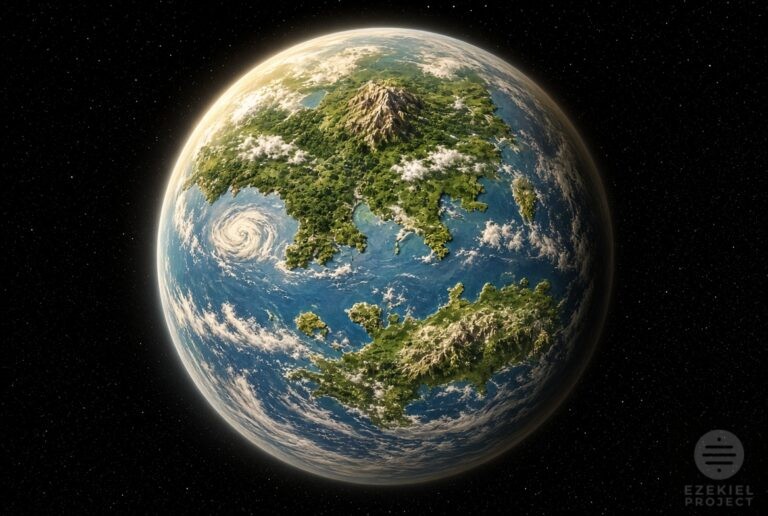
The cornerstone of this new theory points directly to our neighboring planet, Venus. The Ezekiel Project claims that approximately 600 to 700 million years ago, a highly advanced NHI species dominated the Venusian landscape. While modern science views Venus as a toxic, hyper-pressurized furnace enveloped in thick clouds of sulfuric acid, the project paints a vastly different picture of the planet’s ancient past. They assert that during this epoch, Venus was a vibrant, Earth-like sanctuary characterized by vast planetary oceans of liquid water and dense, thriving vegetation. The atmosphere was fully breathable, capable of sustaining complex biological systems, and surface temperatures were remarkably mild, fluctuating between 20 and 50 degrees Celsius, which translates to a comfortable 68 to 122 degrees Fahrenheit.
Faced with a shifting planetary climate or an impending environmental crisis, this ancient Venusian civilization allegedly executed a large-scale exodus to Earth. Upon their arrival roughly 600 million years ago, these beings did not merely establish an outpost; they brought an entire biological infrastructure with them. The Ezekiel Project states that the species transported numerous alien organisms to Earth that served as vital food sources and fulfilled key ecological and structural functions. This massive introduction of extraterrestrial flora and fauna aligns uniquely with the timeline of the sudden diversification of life on Earth, suggesting that what mainstream science views as spontaneous evolution may have actually been the deliberate seeding of a planet.
Over the hundreds of millions of years that followed, the physical presence of the original NHI species shifted. The project suggests two possibilities: the species either faced a quiet extinction or their distinct genetic lineage slowly dissolved into the broader currents of terrestrial evolution, becoming diluted and woven into the fabric of modern organisms.
Despite the profound implications of these assertions, the scientific community remains skeptical, primarily due to the complete lack of verifiable data. The Ezekiel Project has explicitly refused to disclose the origin of their information, stating that the identity of their source must remain strictly confidential for protective reasons. This high level of secrecy has fueled intense speculation among researchers and analysts alike. The prevailing theory among observers is that these specific facts are also in the possession of specialized intelligence agencies within the United States government, where they are maintained under strict classification protocols away from public and academic scrutiny.
According to models put forward by the Ezekiel Project, Venus provided ideal conditions for the emergence and evolution of life over an astonishingly long astronomical timeframe. The research group led by Ezekiel Vacuo asserts that the planet maintained liquid oceans and temperate zones for up to three billion years. This vast window of time, stretching from the planet’s formation roughly 4.5 billion years ago until about 700 to 600 million years ago, was more than sufficient for the establishment of not just simple single-celled organisms, but a highly advanced, technological Non-Human Intelligence species. The project indicates this stability was maintained by a slow planetary rotation that generated dense cloud covers, which acted as a massive thermal shield, deflecting intense solar radiation and keeping global temperatures stable for eons.
The abrupt conclusion of this habitable era was brought about by a catastrophic chain of geological and atmospheric events. According to the Ezekiel Project, the circumstances that rendered Venus entirely uninhabitable resulted from a runaway greenhouse effect that permanently altered the planet’s environment. Massive magmatic provinces erupted simultaneously across the planet because, unlike Earth, Venus lacked a continuous plate tectonics system to gradually release internal heat. This caused energy to build up in the mantle until it triggered widespread, planet-altering volcanic events that released trillions of tons of carbon dioxide into the atmosphere. The atmospheric density spiked drastically, trapping immense amounts of solar heat that could no longer escape into space. Once temperatures crossed a critical threshold, the vast Venusian oceans began to boil, and because water vapor is itself a potent greenhouse gas, the vaporization of the seas created a devastating feedback loop that accelerated the heating process. In the upper atmosphere, intense ultraviolet radiation from the Sun split the evaporated water molecules into hydrogen and oxygen, allowing the lightweight hydrogen to escape permanently into space. Without liquid water, the planet lost its natural mechanism to absorb and trap carbon dioxide back into rock formations.
This irreversible cycle transformed a once-vibrant world into a crushing wasteland with atmospheric pressures ninety times greater than Earth’s and surface temperatures exceeding 450 degrees Celsius, which is over 842 degrees Fahrenheit. For the resident Non-Human Intelligence species facing total extinction 600 million years ago, the only path to survival was a mass migration to the nearest viable sanctuary, which was a young, developing planet called Earth.