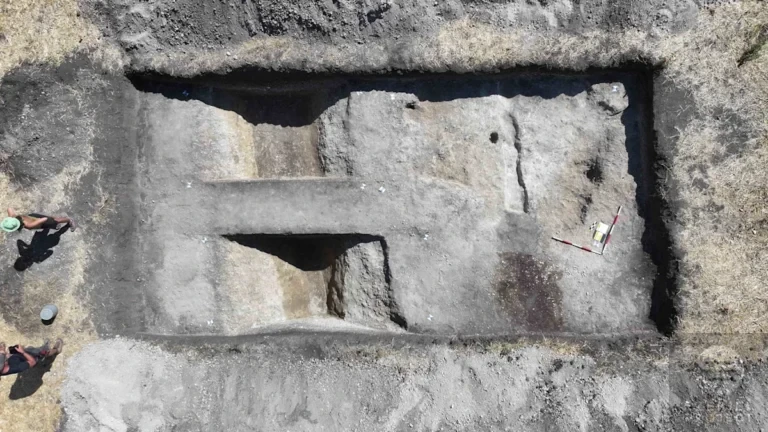
Deep within the lush landscapes near Kalambo Falls, close to the border of Tanzania, a groundbreaking archaeological discovery has sent ripples through the scientific community. A team of researchers unearthed remarkably well-preserved wooden logs – meticulously shaped and joined together by ancient hands. This isn’t just driftwood or a fallen tree; it’s an extraordinary structure that pushes back our understanding of early human ingenuity.
A Structure Older Than Homo Sapiens
Using advanced luminescence dating techniques, scientists have determined that this wooden construction is approximately 476,000 years old – making it the oldest known such structure ever discovered. Astonishingly, the find predates modern humans (Homo sapiens) by an estimated 200,000 years. This raises profound questions about who exactly built it and what their capabilities were.
The prevailing theory suggests that species like Homo heidelbergensis, another key human ancestor known for shaping their environment, inhabited the region at this time. This discovery implies that these earlier hominins possessed a level of sophistication previously attributed to later humans.
The Team Behind the Find
The remarkable find was made in Kalambo Falls, an area renowned for its ability to preserve ancient artifacts. A collaborative research team from the University of Liverpool and Aberystwyth University spearheaded the excavation. Their efforts have unveiled this incredible glimpse into a long-lost past.
“This find has changed how I think about our early ancestors,” stated Professor Larry Barham, one of the lead researchers. “Forget the label ‘Stone Age,’ look at what these people were doing: they made something new and large from wood.”
What Was It For?
The structure itself consisted of two substantial logs. One log was carefully carved with a notch to securely accommodate the other. Researchers believe it may have served as part of a platform, walkway, or even a foundation near the water’s edge. The discovery of associated tools – including a wedge and a digging stick – further supports the evidence of deliberate woodworking.
The Science Behind the Dating
Determining the age of organic material this far back in time is incredibly challenging. Scientists employed luminescence dating, a technique that analyzes when mineral grains within surrounding sediments last absorbed sunlight. By studying these sediments, they pinpointed the structure’s age to approximately 476,000 years ago. The perpetually waterlogged conditions near the falls played a crucial role in preserving the wood, shielding it from decomposition over hundreds of millennia.
A Rare Glimpse Into the Past
Wooden artifacts are exceptionally rare finds in archaeology. Stone tools, being more durable, can endure for millions of years. Wood typically decays long before archaeologists have a chance to uncover it. This makes the Kalambo Falls discovery all the more extraordinary – offering an unprecedented window into early human technology that has largely remained hidden from view.
Redefining Human Evolution
This groundbreaking discovery challenges conventional narratives about human evolution. The traditional “Stone Age” label may have inadvertently minimized the role of other materials in early technologies and construction. The Kalambo Falls wood structure demonstrates that human ingenuity and cultural development were likely more diverse and flexible than previously imagined, prompting scientists to reconsider our understanding of early human capabilities. It suggests a far richer tapestry of innovation than we’ve traditionally acknowledged.