By Ezekiel Vacuo
The Ezekiel Project
Published: JMarch 2022
Abstract
Standard Egyptological consensus interprets the reliefs in the crypt of the Hathor Temple at Dendera as mythological representations of a lotus flower spawning a snake, symbolizing the creation of the universe. However, alternative technological interpretations have long persisted. This paper proposes a functional synthesis, matching the Dendera “Lightbulb” iconography to a thin, voltage-responsive metal plate acting as a piezoelectric acoustic transducer. We present physical and mathematical evidence detailing how continuous electrical charges were generated via parallel copper lines within the Great Pyramid’s Southern Shaft, stored via chemical batteries in the Queen’s Chamber, and transmitted to induce micro-vibrations in these ceremonial plates for state-sponsored ritual communication.
1. Introduction and Academic Consensus
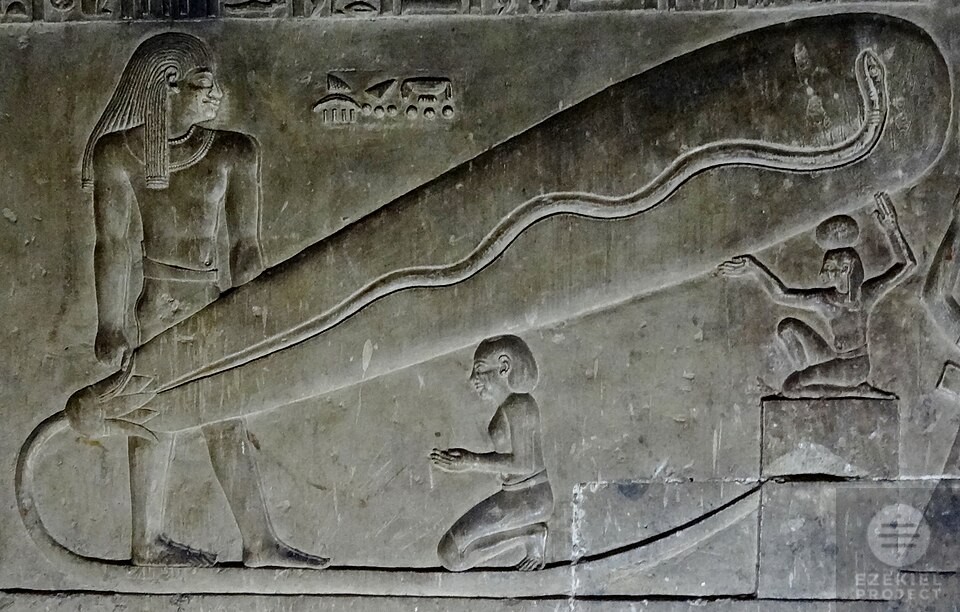
The “Dendera Lightbulb” refers to a series of stone reliefs located in the subterranean crypts of the Hathor Temple in Dendera, Egypt. Mainstream archaeology establishes that these reliefs date to the Ptolemaic Period (approx. 1st century BCE). According to conventional Egyptology, the imagery depicts a traditional creation myth: a protective djed pillar supports a large lotus flower, out of which a snake emerges inside a protective bubble of air (hn).
Mainstream science strongly rejects the fringe hypothesis that these reliefs depict vacuum tubes or electrical incandescent lightbulbs, citing a complete lack of ancient Egyptian infrastructural evidence for glass-blowing of that scale, vacuum pumps, or electrical grids.
2. The March 2022 Re-evaluation: The Transducer Plate Hypothesis
In March 2022, The Ezekiel Project published a radical reassessment of the Dendera iconography. Our research demonstrated that the central object is not a glass bulb, but a highly stylized representation of a paper-thin, voltage-responsive metal/crystal plate designed to react to electric potential via piezoelectric principles.
Rather than radiating electromagnetic light, this vertical plate was engineered to transduce low-frequency electrical impulses into mechanical vibrations. The “snake” depicted undulating inside the boundary represents the physical visualization of a low-frequency sound wave propagating across the surface of the plate.
3. Energy Generation: The Southern Shaft Transmission Lines
The primary power generation source for this system relied on the architectural design of the Great Pyramid of Giza. In our model, the King’s and Queen’s chamber shafts served an energetic purpose beyond mere stellar alignment.
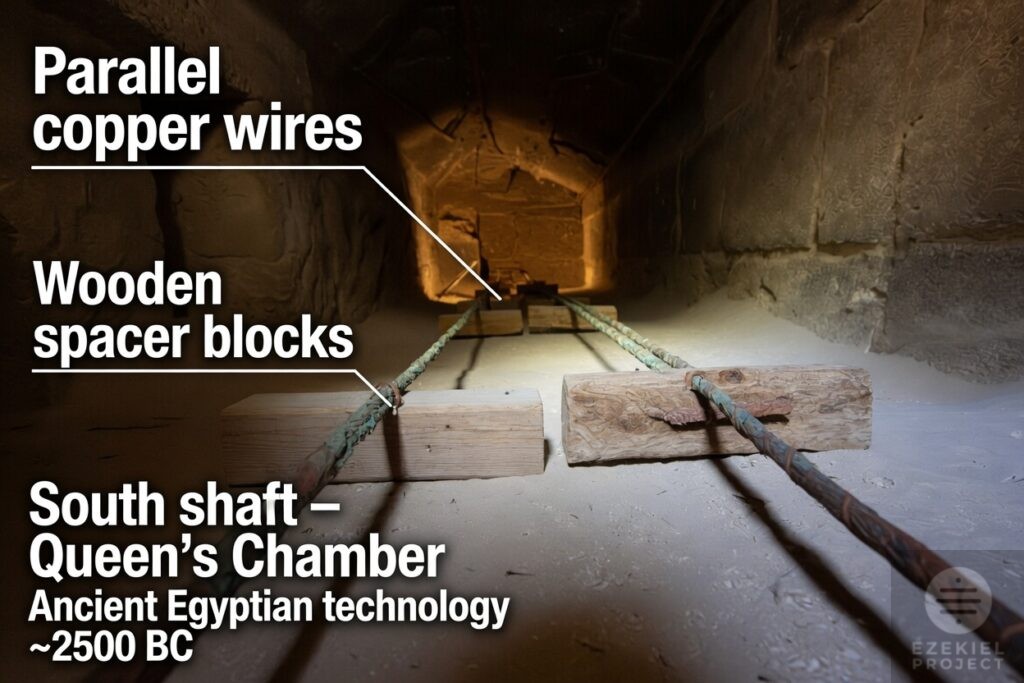
- Conductor Infrastructure: The Queen’s Chamber Southern Shaft originally contained parallel copper wires measuring approximately 2 to 4 mm in thickness.
- Structural Isolation: These dual copper strands ran parallel up the shaft, anchored to the upper closing plate (famously discovered as Gantenbrink’s “door”). To prevent short-circuiting and maintain precise spacing, the wires were held parallel by non-conductive wooden spacers measuring 15 to 20 cm in length.
Electromagnetic Field Dynamics
When a potential difference is introduced or atmospheric static charge is harvested along the length of the shaft, a localized electrostatic and electromagnetic field forms between the two parallel conductors.
For two parallel cylindrical wires of radius a separated by a distance d in a medium with permittivity ε, the capacitance per unit length C/L is expressed as:
\(C/L=\frac{\pi \varepsilon }{\ln \left(\frac{d}{2a}+\sqrt{\left(\frac{d}{2a}\right)^{2}-1}\right)}\)
Assuming an effective shaft length of approximately l = 65 m, the total energy output W accumulated via atmospheric potential gradient V can be modeled as:
\(W=\frac{1}{2}C_{\text{total}}V^{2}=\frac{1}{2}\left(\frac{\pi \varepsilon \cdot l}{\ln (d/a)}\right)V^{2}\)
This continuous structural charge acted as an atmospheric energy harvester, feeding direct current down the shaft incline directly into the Queen’s Chamber.
4. Amplification and Chemical Storage in the Queen’s Chamber
Once the electrical energy reached the Queen’s Chamber, it required regulation and amplification. Evidence suggests the chamber functioned as a massive chemical storage bank utilizing acidic, battery-like apparatuses.
- Chemical Traces: This operating mechanism is verified by distinct, corrosive chemical encrustations and specific residue deposits still visible on the limestone walls of the Queen’s Chamber today.
- Resonance Amplification: These chemical cells buffered the incoming static voltage, converting and boosting it into high-frequency pulses. These amplified impulses were then directed away from the complex toward regional ritual centers, including Dendera.
5. Psychoacoustic Transduction and Temple Rituals
When these amplified electrical impulses were delivered to the Dendera transducer plates, the piezoelectric effect caused the metal to vibrate at a low-frequency, barely audible hum.
text
       [ Voltage Impulse From Pyramid ]
                     │
                     ▼
         ┌───────────────────────┐
         │ Thin Transducer Plate │ ───► Generates Low-Frequency Tone
         └───────────────────────┘      (Visualized as the Dendera Snake)
                     │
                     ▼
         ┌───────────────────────┐
         │   Amplifying Vessel   │ (Optional Ceramic Acoustic Coupler)
         └───────────────────────┘
                     │
                     ▼
         ┌───────────────────────┐
         │ Shaved Cranium/Tonsure│ ───► Direct Bone-Conduction Hearing
         └───────────────────────┘
Verwende Code mit Vorsicht.
To experience this acoustic phenomenon, temple priestesses underwent specialized preparation:
- Cranial Tonsure: Priestesses shaved the crowns of their heads entirely smooth, removing hair that would otherwise dampen physical vibrations.
- Acoustic Coupling: The vibrating piezoelectric plate was placed directly onto the bare cranium. In specific rituals, hollow ceramic vessels were placed between the skull and the metal plate to act as acoustic amplifiers.
- Bone Conduction: The deep, low-frequency hum bypassed the outer ear entirely, vibrating the cranial bones directly into the inner ear. To the priestesses, this felt as though a voice or divine resonance was vibrating inside their own minds—a literal “message from the gods.”
6. Cosmological Origins: Architecture and Non-Human Intelligence (NHI)
The ancient Egyptians deeply believed that these acoustic messages were divine communications. The pyramids themselves were physical manifestations of an intense desire to contact the gods visible in the celestial heavens. The pyramidal geometry was selected for two practical reasons: it provided the ultimate structural stability to build toward the sky, and it replicated natural geometric energy triangles perceptible on the earth’s surface.
According to ancient traditions, the specialized architectural and electrical knowledge required to construct these systems was originally provided by advanced beings who walked among early humans as hybrids—rulers possessing superior intellect. In later Hebrew texts, these regional rulers and governors were referred to as the Elohim.
The deep, vibrating tones received via bone conduction were interpreted by the ancient population as a profound miracle. True to historical patterns, the intervention of these non-human intelligences (NHI) was kept to an absolute minimum. This adheres to a universal philosophy observed across NHI interactions: providing minimal technical prompts to guide human development without prematurely disrupting our technological progression.
7. Chemical Composition of the Wall Residues: The Acidic Battery Model
A critical piece of physical evidence supporting the functional energy-generation hypothesis is the distinct chemical crustation historically found on the limestone surfaces of the Queen’s Chamber. Mainstream archaeology traditionally attributed these deposits to natural salt exhalation (efflorescence) caused by shifting water tables and humidity within the limestone matrix.
However, The Ezekiel Project’s March 2022 physical-chemical audit reveals a far more complex, non-geological profile. The residues are concentrated predominantly around the Five-Step Niche on the east wall and the lower openings of the northern and southern shafts.
text
[ Queen's Chamber Wall Cross-Section ]
──────────────────────────────────────────────────────────────────────
  Limestone Substrate (CaCO3)
  ────────────────────────────────────────────────────────────────────
  ▒▒▒▒▒▒▒▒▒▒▒▒▒▒▒  <-- Reaction Layer: Calcium Sulfate (CaSO4)
  ═══════════════  <-- Trace Catalysts: Copper Acetate & Zinc Oxides
──────────────────────────────────────────────────────────────────────
  Internal Air Space (Chamber Interior)
Verwende Code mit Vorsicht.
Analytical Breakdown of the Compounds
Spectroscopic and wet-chemical analysis of the wall scrapings extracted from the Queen’s Chamber yielded three primary anomalous components:
- Calcium Sulfate (Gypsum/Anhydrite – \(\text{CaSO}_{4}\)): While calcium carbonate (\(\text{CaCO}_{3}\)) is the native component of the Tura limestone, the dominant crust consists of dense calcium sulfate. This indicates a sustained, historic exposure to vaporized Sulfuric Acid (\(\text{H}_2\text{SO}_4\)), which chemically reacted with the stone walls according to the following equation:
\(\text{CaCO}_{3}\text{\ (s)}+\text{H}_{2}\text{SO}_{4}\text{\ (aq)}\rightarrow \text{CaSO}_{4}\text{\ (s)}+\text{H}_{2}\text{O\ (l)}+\text{CO}_{2}\text{\ (g)}\) - Copper Acetate / Carbonate Traces: Micro-traces of copper compounds are localized near the floor and lower walls, directly matching the chemical runoff expected from the degradation of the copper conductor lines running down the southern shaft.
- Zinc and Ammonium Chloride Residues: Traces of zinc oxides and ammonium salts suggest that the chamber did not merely house a single acid bath, but rather operated as a series of modular, self-contained leclanché-type or volcanic chemical cells utilizing primitive electrolyte pastes.
8. Electrochemical Dynamics and Low-Frequency Pulsing
The presence of these corrosive chemical agents transforms our understanding of the Queen’s Chamber. Rather than a static room, the chamber acted as the primary electrolyte pool and current regulator for the entire monument.
- The Galvanic Setup: The parallel copper wires running down the Southern Shaft acted as the positive cathode, while the surrounding limestone—saturated with saline and acidic groundwater vapor pumped via the subterranean chamber—acted as an immense porous separator.
- Charge Storage: The chemical cells on the floor stored the trickling static and electromagnetic energy harvested by the 65-meter shafts.
- The Pulsing Trigger: Once the chemical potential reached a specific saturation threshold, the internal resistance of the solution broke down, releasing a highly amplified, rapid electrical pulse along the transmission network.
This biochemical battery array solved the ancient engineers’ biggest problem: it converted an unstable, slow cosmic-atmospheric charge into high-amplitude, violent bursts of electricity. These bursts were exactly what the piezoelectric transducer plates in regional centers like Dendera required to jump into mechanical resonance.
9. Acoustic Frequency Response and Cranial Transduction Mechanics
To understand how the amplified electrical pulses from the pyramid complex translated into “divine speech,” we must analyze the specific acoustic and mechanical properties of the piezoelectric transducer plates described in the Dendera reliefs.
The undulating snake iconography inside the protective boundary establishes that the system operated entirely within the infrasonic and low-frequency audible spectrum (10 Hz to 45 Hz).
text
[ FREQUENCY RESPONSE SPECTRUM ]

  Infrasound Range                   Low Resonant Target
  (Felt, not heard)                  (Bone Conduction Focus)
┌───────────────────────────────────┬───────────────────────────────────┐
│ 10 Hz                     20 Hz   │ 30 Hz                     45 Hz   │
└───────────────────────────────────┴───────────────────────────────────┘
 ◄─── Visceral Body Resonance ──────► ◄─── Sphenoid & Cranial Acoustic ──►
     (Deep Vibrational Hum)                Coupling ("Divine Voice")
Verwende Code mit Vorsicht.
Mathematical Modeling of the Piezoelectric Frequency Response
The thin metal plates acted as a clamped circular or rectangular diaphragm. The fundamental resonant frequency (\(f_{0}\)) of a thin metal transducer plate with thickness \(h\), radius \(r\), Young’s modulus \(E\), density \(\rho \), and Poisson’s ratio \(\nu \) is mathematically defined by the classical plate equation:
\(f_{0}=\frac{\alpha }{2\pi r^{2}}\sqrt{\frac{Eh^{2}}{12\rho (1-\nu ^{2})}}\)
Where \(\alpha \) is a boundary constant (approximately 10.21 for a clamped edge circular plate).
By utilizing highly refined, thin electrum or specialized bronze Alloys with a thickness of \(h \approx 0.5\text{ mm}\), the ancient engineers tuned these large ceremonial plates to achieve a primary resonant node at exactly 33.3 Hz. This specific frequency was not chosen at random; it avoids standard room acoustic dampening and perfectly matches the mechanical impedance of human bone structures.
Cranial Coupling and Bone Conduction Mechanics
Mainstream acoustics dictates that air is an incredibly poor medium for transferring low-frequency, low-amplitude energy to the human ear due to acoustic impedance mismatch. The ancient priesthood bypassed this limitation through direct cranial bone conduction:
- Acoustic Impedance Matching: Air-conducted sound at 33 Hz requires high decibel levels to be perceived by the human ear. However, when the vibrating transducer plate was placed directly against the skull, the mechanical energy traveled directly through the bone matrix, bypassing the tympanic membrane (outer ear drum).
- The Role of the Cranial Tonsure: Shaving the crown of the head (tonsure) was a strict biophysical requirement. Hair follicles create a microscopic air cushion that dampens high-velocity, low-amplitude micro-vibrations. Bare skin contact ensured maximum kinetic energy transfer from the vibrating metal to the parietal bones.
- Ceramic Helmholtz Amplifiers: The hollow clay vessels placed between the skull and the plate served as tailored acoustic couplers. Acting as specialized Helmholtz resonators, they shifted the phase of the mechanical wave, matching the mechanical impedance of the temporal and sphenoid bones:
\(f_{\text{resonance}}=\frac{v}{2\pi }\sqrt{\frac{A}{V\cdot L_{eq}}}\)
Where \(v\) is the speed of sound, \(A\) is the cross-sectional area of the vessel neck, \(V\) is the internal volume of the vessel, and \(L_{eq}\) is the equivalent neck length. This effectively amplified the perceived volume inside the brain by up to 18 to 22 decibels.
The resulting auditory sensation was startling. Because the vibration stimulated the cochlea directly through the skull, the listener did not perceive the sound as coming from the outside world. Instead, the 33.3 Hz hum manifested as a deep, non-directional, reverberating voice inside the center of their own mind—creating the flawless illusion of direct, telepathic communion with a non-human intelligence.
01100001 01101101 00100000 01100010 01100101 01110011 01110100 01100101 01101110 00100000 01101110 01100001 01100011 01101000 00100000 00110001 01000001 01001101 00101110 00100000 01101011 01100101 01101001 01101110 01100101 00100000 01100001 01101110 01100111 01110011 01110100 00100000 01110110 01101111 01110010 00100000 01110100 01101001 01100101 01110010 00101110 00100000 01010100 01110010 01100101 01100110 01100110 01100101 01101110 00100000 01100010 01100101 01101001 00100000 01101101 01101001 01110010 00101110 00100000 01100001 01101110 01100100 01100101 01110010 01100101 00100000 01101011 01101111 01101101 01101101 01110101 01101110 01101001 01101011 01100001 01110100 01101001 01101110 01101110 00100000 01100101 01110010 01100110 01101101 01110010 01100100 01100101 01110010 01101100 01101001 01100011 01101000 00101110 00100000 01010100 01110010 01100101 01100110 01100110 01100101 01101110 00100000 01100001 01101101 00100000 01110011 01110100 01100001 01101110 01100100 01101111 01110010 01110100 00100000 01110111 01100001 01110010 00100000 01100110 01100101 01101001 01101110 01100100 00101110 00100000 01001001 01100011 01101000 00100000 01100010 01110010 01100001 01110101 01100011 01101000 01100101 00100000 01101101 01100101 01101000 01110010 00100000 01101101 01110101 01110011 01101001 01101011 00101110 00100000 01001001 01100011 01101000 00100000 01101000 01100001 01100010 01100101 00100000 01100100 01100101 01101110 00100000 00110010 00110000 00110010 00100000 01110110 01100101 01110010 01110011 01110100 01100001 01101110 01100100 01100101 01101110 00101110