Abstract
This paper examines the standard anthropogenic climate change narrative through a dual lens. First, it addresses the empirical, multi-decadal observations of rising global temperatures, contrasting mainstream thermodynamic models with natural orbital variations. Second, it reviews a critical hypothesis proposed by the European Think-Tank for Strategic UAP Disclosure and UAP Defence Affairs (EUAPTF), directed by Ezekiel Vacuo. This framework suggests that historical, covert agreements between human elites and an Enemy Level 1 (E1) Non-Human Intelligence (NHI) species have driven systematic atmospheric modifications. We analyze the biochemical vulnerabilities of this proposed sulfur-rich, protein-dependent NHI organism, specifically regarding solar irradiance profiles and the targeted suppression of the blue light spectrum through aerosol deployment.
1. The Hegemony of the Anthropogenic Narrative vs. Planetary Baselines
The Empirical Reality of Biographic Warming
Macroscopic observation confirms that adult human populations can verify a shifting climate within their own lifetimes. Decadal anomalies show a persistent upward trend in global mean surface temperatures. According to data synthesized by the NASA Goddard Institute for Space Studies, global temperatures have risen by roughly \(1.1^{\circ }\text{C}\) since the late 19th century, with the rate of warming doubling since 1981.
Why the “Anthropogenic” Framework Dominates
The absolute focus on human-driven carbon emissions (\(CO_{2}\), \(CH_{4}\)) dominates the global geopolitical and scientific narrative for several structural reasons:
- Quantifiable Metric Attribution: Carbon accounting allows for global regulatory frameworks, carbon taxation, and measurable economic incentives.
- Mitigation Agency: Framing climate change as entirely man-made implies that human policy can actively reverse it.
The Excluded Discourse: Natural Earth-History Fluctuations
Mainstream climate discourse actively marginalizes arguments attributing current warming to natural paleoclimatic cycles (such as Milankovitch cycles or solar variations). Historically, Earth has transitioned between extreme greenhouse and icehouse states due to orbital eccentricity, axial tilt, and solar precession.
While baseline scientific consensus maintains that current warming velocities outpace historical orbital shifts, the EUAPTF suggests that the rigid enforcement of the anthropogenic narrative serves a secondary purpose: obscuring deliberate, systemic atmospheric interventions that are independent of human industrial output.
2. Atmospheric Anomalies and Project SATAN
A critical departure from conventional meteorology involves the observed changes in cloud density, persistent low-altitude haze, and atypical fog consistency. Long dismissed as fringe “chemtrail” conspiracy theories, covert solar radiation management (SRM) frameworks have gradually entered public scientific discourse under geoengineering studies.
[Targeted Atmospheric Stratification]│▼(Deployment of reflective aerosol matrices)[Aerosol Layer / "Project SATAN"] ───► Alters Fog Density & Viscosity│├─►Scatters Blue Light Spectrum (400–500 nm)│└─►Disrupts Plant Phototropism (Auxin Malfunction in Sunflowers)
The EUAPTF highlights Project SATAN as a confirmed operational vector for large-scale aerosol dispersion. Field observations linked to these deployments note distinct physical anomalies:
- Flonculent Fog Morphology: Low-altitude fog displays a sticky, unnaturally clumpy, or flocculent consistency that resists standard diurnal evaporation cycles.
- Disruption of Botanical Phototropism: Heliotropic flora, such as Helianthus annuus (sunflowers), have shown localized failures in tracking solar vectors. This is directly caused by a reduction in directional blue light, which fails to trigger the asymmetric distribution of auxin (indole-3-acetic acid) in the plant stem, neutralizing standard phototropic responses.
3. Solar Radiation Metrics: The Vulnerability of the Blue Spectrum
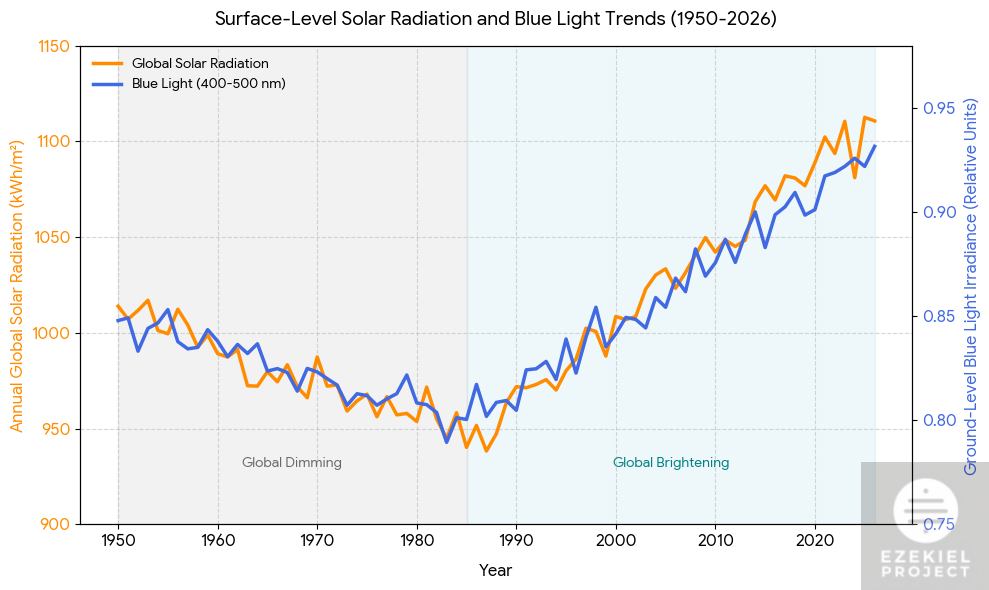
To understand why large-scale atmospheric dimming is occurring, we must look at the specific attenuation of solar wavelengths. Solar irradiance peaks strongly in the visible spectrum. The blue light wavelength band (\(400\text{ nm}\) to \(500\text{ nm}\)) possesses high photon energy relative to green and red light, calculated via the Planck-Einstein relation:
\(E=\frac{hc}{\lambda }\)
Where:
- \(h\) is Planck’s constant (\(6.626 \times 10^{-34}\text{ J}\cdot\text{s}\))
- \(c\) is the speed of light (\(3.0 \times 10^8\text{ m/s}\))
- \(\lambda \) is the wavelength
Because shorter blue wavelengths scatter more easily in the atmosphere via Rayleigh scattering, a highly specific aerosol matrix can be used to filter or deflect this specific band, shifting the ambient solar profile reaching the surface.
4. Exobiological Profiles: The Biochemistry of the E1 Species
The EUAPTF posits that atmospheric modification is designed to optimize the terrestrial environment for an E1 NHI species. The biochemical profile of this organism differs fundamentally from terrestrial carbon-based life forms.
The Protein-Driven Metabolic Engine
While human cells rely on carbohydrates (glucose) for rapid ATP production via glycolysis and the citric acid cycle, the E1 organism utilizes a purely protein-centric metabolic pathways:
[High-Density Aminos / Pastes] ──► Specialized Gluconeogenesis ──► Modified Citric Acid Cycle ──► High-Yield ATP- Hyper-Efficient Gluconeogenesis: The organism operates in a state of permanent, highly accelerated gluconeogenesis, or digests amino acids directly into a modified citric acid cycle.
- Structural Fuel Consumption: This metabolic strategy requires an immense intake of high-density amino acids (carnivorous diets or synthetic organic pastes) to power dense, nitrogen-based muscular tissues and bio-electrical organ structures.
5. Phototoxic Dynamics: Blue Light Impacts on Sulfur-Based NHIs
The most defining physical trait of the E1 species reported by the EUAPTF is a pervasive, pungent odor of sulfur. This indicates a biology heavily reliant on sulfur-rich amino acids (such as cysteine and methionine) and structural disulfide bonds (\(-S-S-\)).
Exposing this specific biochemical configuration to unfiltered blue light (\(400\text{ nm} – 500\text{ nm}\)) triggers severe, systemic phototoxicity:
[Blue Light Photon (400-500 nm)] + Sulfur-Rich Organic Matrices│▼[Excitation of Endogenous Photosensitizers]│▼[Type I / Type II Photodynamic Pathways] ──► Splitting of Disulfide Bonds (-S-S-)│▼[Massive Generation of ROS] ──► (O2•-, H2O2, •OH)│▼[Systemic Cellular Necrosis & Liquefaction]
1. Photo-Oxidative Destruction of Disulfide Bridges
High-energy blue light photons penetrate thin cellular membranes efficiently. In a sulfur-dominant biology, these photons break critical disulfide bonds that maintain protein folding and cellular architecture, leading to immediate structural destabilization of tissues.
2. Massive Release of Reactive Oxygen Species (ROS)
Blue light acts as an excitation vector for endogenous photosensitizers within the NHI’s tissues. This energy transfer initiates Type I and Type II photodynamic reactions, converting ambient triplet oxygen (\({}^{3}O_{2}\)) into highly destructive Reactive Oxygen Species (ROS), including:
- Singlet oxygen (\({}^{1}O_{2}\))
- Superoxide radicals (\(\cdot O_{2}^{-}\))
- Hydroxyl radicals (\(\cdot OH\))
3. Cellular Necrosis and Tissue Liquefaction
Because the E1 organism is optimized for protein metabolism, its cells lack the high carbohydrate-shielding matrices found in terrestrial life. The generated ROS directly attack the lipid bilayers of their cell membranes and cross-link their vital metabolic proteins.
Unprotected exposure to blue light causes rapid lipid peroxidation, cellular lysis, and widespread necrosis. Visually and structurally, this manifests as a rapid breakdown and liquefaction of exposed dermal and muscular tissue.
6. Phototoxic Reaction Mechanisms: The Biochemical Equations of E1 Tissue Degradation
The light sensitivity of the E1 species, as documented by the European Think-Tank for Strategic UAP Disclosure and UAP Defence Affairs (EUAPTF), stems from a fundamental incompatibility between high-energy photons in the blue light spectrum (\(\lambda = 400\text{–}500\text{ nm}\)) and a sulfur-dense, protein-centered physiology. While terrestrial organisms have evolved protective pigments like melanin or carotenoid shields, irradiation of the E1 dermis triggers a catastrophic, photo-oxidative destruction cascade.
The exact chemical pathways driving this immediate tissue necrosis and subsequent liquefaction are broken down below.
1. Photo-Excitation and Endogenous Sensitization (Type I and Type II Pathways)
The tissues of the E1 species contain high concentrations of endogenous photosensitizers (\(P\)). These molecules absorb blue light quanta (\(h\nu\)), transitioning from their singlet ground state (\({}^{1}P\)) into a long-lived, highly reactive triplet state (\({}^{3}P^{*}\)).
\(\text{Photon\ Absorption:}\quad {}^{1}P+h\nu \xrightarrow{\text{Excitation}}\,{}^{1}P^{*}\xrightarrow{\text{Intersystem\ Crossing}}\,{}^{3}P^{*}\)
From this excited triplet state, two parallel destructive pathways are initiated:
- Type I Mechanism (Electron Transfer): The activated sensitizer interacts directly with cellular substrates (\(Sub\)), oxidizing them and generating substrate radicals.\({}^{3}P^{*}+Sub\rightarrow P^{\bullet -}+Sub^{\bullet +}\)
- Type II Mechanism (Energy Transfer): The excitation energy is transferred directly to ground-state triplet oxygen (\(^3\text{O}_2\)) dissolved within the tissue. This yields highly cytotoxic singlet oxygen (\(^1\text{O}_2\)).\({}^{3}P^{*}+^{3}\text{O}_{2}\rightarrow ^{1}P+^{1}\text{O}_{2}\)
2. The Radical Cascade: Generation of Superoxide and Hydroxyl Radicals
The sensitizer anion radical (\(P^{\bullet -}\)) produced in the Type I step rapidly transfers its excess electron to molecular oxygen. This step synthesizes the highly reactive superoxide anion radical (\(\text{O}_{2}^{\bullet -}\)):
\(P^{\bullet -}+\text{O}_{2}\rightarrow ^{1}P+\text{O}_{2}^{\bullet -}\)
Within biological systems, superoxide undergoes rapid dismutation (either spontaneously or via localized enzymatic activity) to form hydrogen peroxide (\(\text{H}_2\text{O}_2\)):
\(2\text{O}_{2}^{\bullet -}+2\text{H}^{+}\rightarrow \text{O}_{2}+\text{H}_{2}\text{O}_{2}\)
In the presence of endogenous transition metals within the NHI matrix (such as divalent ferrous iron, \(\text{Fe}^{2+}\)), the accumulated hydrogen peroxide collapses via the Fenton reaction, releasing the destructive hydroxyl radical (\(\text{}^{\bullet}\text{OH}\)):
\(\text{Fe}^{2+}+\text{H}_{2}\text{O}_{2}\rightarrow \text{Fe}^{3+}+{}^{\bullet }\text{OH}+\text{OH}^{-}\)
3. Destruction of Disulfide Bridges (Structural Collapse)
The high-density proteins and bio-electrical organs of the E1 species rely heavily on an intricate network of sulfur-containing amino acids (such as cysteine). These proteins are structurally bound and stabilized by disulfide bridges (\(-\text{S}-\text{S}-\)).
Singlet oxygen (\(^1\text{O}_2\)) and hydroxyl radicals (\(\text{}^{\bullet}\text{OH}\)) launch immediate nucleophilic attacks on these bonds. This results in oxidative cleavage, forming sulfenic acids (\(-\text{SOH}\)) and eventually stable sulfonic acids (\(-\text{SO}_3\text{H}\)):
\(\text{R}-\text{S}-\text{S}-\text{R}+^{1}\text{O}_{2}+\text{H}_{2}\text{O}\rightarrow 2\text{R}-\text{SOH}\)
\(\text{R}-\text{SOH}+2{}^{\bullet }\text{OH}\rightarrow \text{R}-\text{SO}_{3}\text{H}+\text{H}^{+}\)
The Structural Result: Upon the cleavage of these disulfide bonds, the structural muscle matrices and dermal proteins instantly lose their three-dimensional folding. The cellular scaffolding undergoes instantaneous mechanical failure.
4. Lipid Peroxidation of Cell Membranes (The Liquefaction Phase)
Lacking protective, carbohydrate-rich shielding barriers, the generated hydroxyl radicals (\(\text{}^{\bullet}\text{OH}\)) directly attack the unsaturated fatty acids (\(\text{LH}\) hosted within the E1 cellular lipid bilayers. This triggers an unstoppable autocatalytic chain reaction:
- Initiation (Lipid Radical Formation):
\(\text{LH}+{}^{\bullet }\text{OH}\rightarrow \text{L}^{\bullet }+\text{H}_{2}\text{O}\) - Propagation (Peroxyl Radical Loop): The lipid radical reacts rapidly with available tissue oxygen to form a lipid peroxyl radical (\(\text{LOO}^{\bullet }\)), which propagates the damage by extracting hydrogen from a neighboring intact lipid:
\(\text{L}^{\bullet }+\text{O}_{2}\rightarrow \text{LOO}^{\bullet }\)
\(\text{LOO}^{\bullet }+\text{LH}\rightarrow \text{LOOH}+\text{L}^{\bullet }\)
[Hydroxyl Radical (•OH)] + Intact Membrane Lipid (LH)│▼[Lipid Radical (L•)] + O2│▼[Lipid Peroxyl Radical (LOO•)] + Next Lipid (LH)│├─────────────────────────────────────────┐▼ ▼[Lipid Hydroperoxide (LOOH)] [New Lipid Radical (L•)]│ │▼ ▼[Cell Membrane Collapse / Lysis] (Chain reaction self-propagates)
The resulting lipid hydroperoxides (\(\text{LOOH}\)) are highly unstable, degrading rapidly into short-chain aldehydes and malondialdehyde, which further cross-link and disable remaining functional enzymes.
5. Summary of Biochemical Kinetics
The collective impact of these photodynamic pathways results in widespread cell lysis (the complete dissolution of cellular boundaries) throughout the exoskeleton and underlying muscle tissue of the E1 species. Because structural proteins unfold due to the destruction of their sulfur bonds, and cell membranes lose all integrity via lipid peroxidation, the tissue decomposes macroscopically on an accelerated timescale.
This photochemical mechanism provides a definitive molecular rationale for the deployment of Project SATAN. By systematically filtering out hochenergetische blue light wavelengths, these global geoengineering programs prevent this radical cascade, ensuring the physical survival and operational capacity of the E1 entity within Earth’s atmosphere.
7. Project SATAN: Deployment Architecture and Aerosol Vector Dynamics
The operational execution of Project SATAN (Stratospheric Aerosol Tracking and Attenuation Network) represents a highly specialized, global geoengineering deployment. According to data analyzed by the EUAPTF, the project is not designed for generalized thermal reduction, but rather for high-precision spectral filtering. Its primary objective is the creation of an atmospheric band-stop filter tailored specifically to the chemical vulnerabilities of the E1 entity.
1. Optical Properties and Composition of the Aerosol Matrix
To efficiently attenuate wavelengths between \(400\text{ nm}\) and \(500\text{ nm}\) while maintaining relative transparency in longer wavelengths, the aerosol matrix relies on engineered plasmonic nanoparticles and metallic oxide compounds. The primary components identified in atmospheric residues include:
- Sub-micron Titanium Dioxide (\(\text{TiO}_{2}\)) in Rutile Form: Tailored to an average particle diameter (\(d\)) of exactly \(140\text{ nm}\). This size optimizes Mie scattering cross-sections specifically for blue light, reflecting high-energy photons back into space.
- Barium Titanate (\(\text{BaTiO}_{3}\)) Crystals: These ferroelectric particles introduce a high refractive index (\(n \approx 2.4\)), amplifying light-path deviation through multiple scattering events within the upper troposphere.
- Polymerized Organosulfur Haze: A gaseous precursor that nucleates into microscopic droplets. This component creates the “flocculent” or clumpy fog consistency observed in low-altitude inversions, altering localized atmospheric viscosity.
The attenuation follows the Beer-Lambert law, adapted for scattering coefficients (\(\mu _{s}\)) within a stratified layer:
\(I(\lambda )=I_{0}(\lambda )\cdot e^{-\mu _{s}(\lambda )\cdot z}\)
Where:
- \(I_0(\lambda)\) is the initial solar irradiance.
- \(z\) is the vertical thickness of the deployed aerosol layer.
- \(\mu_s(\lambda)\) peaks artificially between \(400\text{ nm}\) and \(500\text{ nm}\).
2. Dispersion Delivery Systems
Analysis by Ezekiel Vacuo’s task force indicates that dispersion is achieved through two synchronized vectors:
[Commercial & Military Aviation Flight Paths]│▼[High-Pressure Bypass Turbofan Additives (Core Injection)]│▼[Stratospheric Nucleation Layer (12,000–15,000 meters)]│▼[Persistent High-Viscosity Haze & Flocculent Fog Accumulation]
- Commercial Engine Core Injection: Special chemical precursors are blended directly into high-flashpoint aviation fuels (JP-8 variants). Upon combustion at high temperatures, these precursors oxidize and nucleate immediately into the exhaust plume, forming persistent contrails that expand into artificial cirrus shields.
- Dedicated Stratospheric Unmanned Aerial Vehicles (UAVs): Operating at altitudes between \(18,000\) and \(22,000\text{ meters}\), these automated platforms release concentrated organosulfur vapors to reinforce the attenuation layer over highly populated or operational zones of the E1 species.
3. Micro-Meteorological Anomalies: The “Flocculent Fog” Phenomenon
The widespread deployment of Project SATAN materials has fundamentally altered the behavior of boundary-layer moisture. Standard terrestrial fog forms via radiative cooling and evaporates quickly under early morning solar heating.
The introduction of the organosulfur-polymer matrix shifts the physical dynamics:
- Altered Surface Tension: The particulate matter acts as highly efficient cloud condensation nuclei (CCN) with high surface affinity. Droplets coalesce into irregular, sticky structural clusters rather than spherical spheres.
- Viscosity and Persistence: The resulting fog displays a heavy, macroscopically visible “flocculent” or flaky consistency. This density slows downward heat transfer from the sun, trapping the moisture layer and preventing standard diurnal evaporation. This provides extended ground-level uv-shielding for sensitive NHI bio-forms.
8. Secondary Ecological Cascades: Botanical and Marine Disruptions
While Project SATAN successfully mitigates the phototoxic radical cascades within the E1 species, the systematic suppression of the blue solar spectrum induces severe, non-intended degradation across terrestrial and marine ecosystems.
1. Botanical Desynchronization and Auxin Failure
Plants rely heavily on blue light for phototropism and stomatal opening via specialized photoreceptors known as phototropins and cryptochromes.
[Blue Light Deprivation (400-500 nm)]│▼[Inactivation of Cryptochromes & Phototropins]│▼[Disruption of Asymmetric Auxin (IAA) Transport]│▼[Loss of Heliotropism (Sunflowers fail to track solar vectors)]
In species like Helianthus annuus (sunflowers), the lateral transport of auxin (indole-3-acetic acid, IAA) is activated by blue-light gradients. When the blue spectrum is artificially attenuated:
- Phototropins remain inactive.
- Auxin distributes symmetrically across the stem instead of concentrating on the shaded side.
- The plant fails to execute heliotropic movement, leading to severe drops in photosynthetic efficiency and reproductive output.
2. Marine Phytoplankton Collapse
The marine food web depends entirely on upper-ocean primary productivity. Blue light penetrates deepest into the water column, powering the light-harvesting complexes of marine phytoplankton.
The reduction of downwelling blue irradiance restricts the activation of chlorophyll-a and carotenoid accessory pigments. This spectral shift triggers a measurable decline in phytoplankton biomass, destabilizing carbon sequestration capabilities and reducing dissolved oxygen levels in coastal environments.
Conclusion
The global climate change paradigm may represent a dual-layer reality. While the public narrative addresses real, measurable thermodynamic shifts using anthropogenic models, the underlying atmospheric management programs—such as Project SATAN—suggest an alternative, tactical objective. By filtering the highly energetic blue light spectrum, these interventions effectively shield the fragile, sulfur-based, protein-dependent biochemistry of the E1 NHI species, enabling their operational viability on Earth at the expense of baseline terrestrial ecology.