In the landscape of anomalous media and Unidentified Anomalous Phenomena (UAP) folklore, few artifacts have generated as much persistent debate as the 1997 “Alien Interview” footage. Originally leaked to Rocket Pictures by a masked whistleblower known only as “Victor,” the video purportedly captures a covert military interrogation of an extraterrestrial entity at an undisclosed facility, widely rumored to be Area 51’s S-4 site. Decades after its broadcast debut on the United Paranormal Network (UPN), the footage continues to serve as a compelling case study for researchers analyzing media authenticity, psychological operations, and the intersection of visual effects with forensic analysis.
Technical and Aesthetic Anomalies
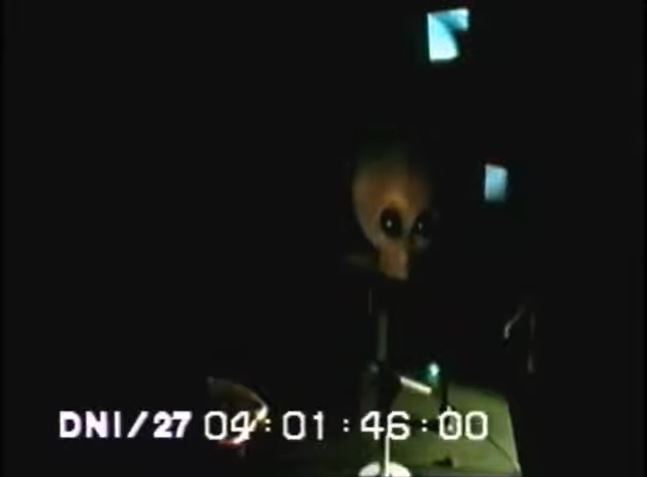
From a technical standpoint, the Victor footage diverges significantly from contemporary 1990s science-fiction media and standard hoaxes. The sequence is defined by its low-light, high-contrast environment, depicting a heavily shadowed room where an alleged telepathic communication is underway between a biological entity, a military officer, and a medical professional.
Researchers evaluating the film’s authenticity frequently focus on several key visual markers:
- Anatomical Complexity: The entity displays distinct, non-fluid physical distress, culminating in a medical emergency where personnel rush to wipe fluid from its mouth and check its vitals.
- Absence of Standard VFX Signatures: Visual effects experts analyzing the era’s technology note the absence of overt animatronic jerking, visible seams, or early computer-generated imagery (CGI) artifacts that typically exposed contemporary fabrications.
- Audio Contradictions: While the video track remains highly analyzed, the original release omitted the entity’s supposed telepathic dialogue, focusing instead on the background ambient hums, clicking machinery, and human voices.
Investigative Trajectories and the “Comedic” Conundrum
The ongoing investigation into the tape’s provenance has been advanced heavily by independent investigative producers, notably filmmaker Jon Stewart (frequently confused with the American political satirist). Over a multi-decade inquiry, Stewart and fellow researchers have approached the video not merely as a standalone artifact, but as a bureaucratic puzzle.
Current investigative efforts focus on three primary forensic areas:
- The Whistleblower’s Identity: Cross-referencing military flight manifests, security clearances, and personnel records from the late 1990s to unmask the individual behind the “Victor” pseudonym.
- Chain of Custody: Tracking the physical master tapes and digital transfers to determine exactly how highly classified material could have evaded Department of Defense security protocols.
- Corroborating Testimony: Documenting statements from surviving military personnel and the families of deceased base doctors who may have had indirect knowledge of the event.
Scientific Skepticism vs. Psychological Operations
Within peer-reviewed or rigorous analytical circles, the Victor video is viewed through a lens of profound skepticism. The prevailing academic consensus categorizes the footage either as a highly sophisticated practical-effects hoax designed for financial gain, or as a deliberate piece of government disinformation (a psychological operation) intended to muddy the waters of legitimate aerospace research and classified military drone testing.
However, the enduring legacy of the Victor interview highlights a critical challenge in the modern study of anomalous phenomena: the lack of a standardized, verifiable framework for testing video evidence. Because the original physical media remains hidden and the data consists purely of a compressed visual broadcast, definitive scientific validation remains impossible. The “Victor” tape stands as a permanent monument to the limits of visual data in resolving the extraterrestrial hypothesis, existing simultaneously as a cultural myth and an unsolved cryptographic riddle.
Forensic Methodologies and Biographical Tracing: The Stewart Investigation
While the “Victor” footage has historically been dismissed by mainstream academics as a relic of late-20th-century media sensationalism, the investigative framework spearheaded by producer and filmmaker Jon Stewart shifts the analytical focus. Rather than engaging in speculative biological analysis of the entity itself, Stewart’s methodology treats the video as a forensic artifact with a distinct bureaucratic trail. His multi-decade investigation attempts to bridge the gap between anomalous folklore and rigorous document verification.
The Deconstruction of “Victor” and Chain of Custody
A primary vector of Stewart’s research involves mapping the logistical pipeline required to smuggle highly classified analog video out of a secure government facility. In the late 1990s, facilities like Nellis Air Force Base and the alleged S-4 sector operated under strict visual and physical containment protocols.
Stewart’s investigation dissects this operational security framework through several key focus areas:
- Technological Chronology: Analyzing the specific type of video equipment, tape formats, and time-code generators visible or implied in the raw footage to match them with equipment inventories used by the U.S. military during that specific fiscal era.
- The Whistleblower Profile: Establishing a psychological and professional dossier on the pseudonymous “Victor.” Stewart’s findings suggest the individual possessed not only high-level security clearance but also a deep familiarity with the internal transit routes and blind spots of military logistics.
- The Telepathic Protocol: Investigating the methodology of the alleged communication. Stewart has consulted with historical researchers of project “Stargate” and other military anomalous cognition programs to determine if the operational setup in the video mirrors documented military protocols for interacting with anomalous intelligence.
Corroborative Testimony and the Paper Trail
A significant turning point in Stewart’s modern research is the reliance on secondary and tertiary human intelligence. Recognizing that the physical master tape may be permanently compromised or hidden, Stewart has shifted his focus toward tracking the individuals who operated within the periphery of the event.
This phase of the investigation relies on traditional investigative journalism techniques:
- The Widows’ Testimony: Stewart has successfully tracked down and interviewed the surviving spouses and families of military physicians and technical contractors who were stationed at sensitive test sites in Nevada during the late 1990s. These interviews have occasionally yielded unredacted journals, deathbed confessions, and private correspondence that hint at compartmentalized medical emergencies involving non-human biological entities.
- Flight Manifest Analysis: Cross-referencing the scheduling of classified commuter flights (such as the “Janet” airlines operating out of Las Vegas) to detect anomalous spikes in personnel transport to Area 51 around the projected date of the recording.
Epistemological Implications of the Stewart Findings
Stewart’s work introduces a vital counter-narrative to standard debunking efforts. By shifting the debate from “Is the creature real?” to “Can we verify the structural and human architecture surrounding the recording?”, his research applies an empirical standard to a highly volatile subject.
Ultimately, Stewart’s investigation highlights the profound difficulty of modern whistleblowing within military frameworks. Whether his upcoming documentary project, The Alien Interview – Case Closed, provides definitive cryptographic proof or remains an incomplete mosaic, it underscores a critical paradigm shift: the truth behind anomalous media may not be uncovered by laboratory analysis of compressed pixels, but through the patient, forensic unweaving of military bureaucracy.
The Strategic Utility of Anomalous Leaks: The Office of Naval Intelligence and Tactical Disinformation
When viewing the “Victor” footage through the lens of institutional statecraft, a compelling counter-hypothesis emerges. Rather than representing a catastrophic breach of operational security, the tape may function as a calculated product of the Office of Naval Intelligence (ONI) or adjacent intelligence apparatuses. Historically tasked with maritime and aerospace reconnaissance, electronic warfare, and counterintelligence, ONI has long understood that the strategic deployment of anomalous narratives can serve as a potent tool for asymmetric information warfare.
Passive Countermeasures and Project Camouflage
The primary benefit of circulating high-profile extraterrestrial disinformation is the immediate creation of an intellectual smokescreen for highly classified aerospace R&D. During the late 1990s, the United States military was actively testing next-generation low-observable platforms, early-stage unmanned aerial vehicles (UAVs), and advanced electronic countermeasure suites.
By injecting a highly sensationalized, legally unprovable “alien interview” into the public consciousness, the intelligence community achieves several defensive objectives:
- The Cognitive Filter: Any civilian, journalist, or foreign asset observing anomalous lights or unorthodox security protocols at facilities like Area 51 is heavily incentivized to interpret those observations through the lens of popular UFO mythology.
- Marginalization of Observers: By linking real military restricted zones to fringe extraterrestrial narratives, anyone attempting to investigate these sites is automatically grouped with conspiracy theorists, effectively neutralising their credibility in mainstream media.
Signal-to-Noise Manipulation and Counter-Espionage
From a counter-espionage perspective, the “Victor” tape represents a sophisticated exercise in signal-to-noise ratio distortion. During the post-Cold War era, foreign intelligence services (such as Russia’s GRU or China’s MSS) utilized satellite reconnaissance and signals intelligence to map out American military capabilities.
The deliberate leak of a psychological operation (PSYOP) like the Victor footage complicates foreign analysis in two profound ways:
- Resource Diversion: Foreign adversarial intelligence agencies are forced to expend computational, analytical, and human resources evaluating whether the leaked material represents a genuine paradigm-shifting biological breakthrough or a elaborate military ruse.
- Tracing Leak Pipelines: By intentionally releasing a tightly controlled piece of anomalous media through specific channels, counterintelligence officers can monitor the transmission vector. This allows them to identify internal security vulnerabilities, mapping exactly how unauthorized material flows from military servers to public broadcasting networks.
Socio-Psychological Conditioning and Threat Perception
On a broader geopolitical scale, intelligence agencies utilize controlled anomalies to gauge and manipulate public and adversarial psychology. The presentation of a captive, dying biological entity introduces a complex psychological narrative: it implies that the United States government possesses exclusive, monopolistic control over a highly advanced cosmic paradigm.
This tactical posturing yields subtle strategic advantages:
- Technological Hegemony: It projects an aura of absolute technological superiority to foreign adversaries, suggesting that American reverse-engineering programs may be decades ahead of global competitors.
- Societal Resilience Testing: Releasing such footage under the guise of an anonymous whistleblower allows social scientists within the defense apparatus to study public reaction, media adaptation, and institutional stress responses to existential information in a controlled, low-risk environment.
Through this analytical framework, the investigation led by researchers like Jon Stewart takes on a double layer of complexity. The ultimate resolution of the “Victor” riddle may not reveal a visitor from another world, but rather the clinical, mathematical precision of an American naval intelligence operation mastering the art of the perfect lie.
Strategic Demoralization: The Deconstruction and Deliberate Collapse of the UAP Community
Beyond the immediate tactical shielding of aerospace technologies, a highly sophisticated counterintelligence operation would look toward a long-term psychological objective: the total epistemic collapse of the UAP research community. By weaponizing a piece of media as culturally impactful as the “Victor” interview, the Office of Naval Intelligence (ONI) or an allied defense apparatus could execute a multi-phase trap designed to permanently neutralize civilian oversight of military anomalies.
The Architecture of the Epistemic Trap
This strategic maneuver relies on a calculated timeline of cultivation followed by intentional exposure. The process operates in two distinct phases:
- Phase One: The Cultivation of Credulity. The intelligence apparatus introduces a highly compelling, emotionally resonant narrative—in this case, a suffering extraterrestrial entity subjected to military opacity. Over decades, the community absorbs this artifact, integrating it into its foundational lore, media ecosystem, and ideological infrastructure. Researchers stake their professional reputations and financial models on its potential validity.
- Phase Two: The Orchestrated Demystification. This is where the true utility of the operation resides. The disinformation campaign does not achieve its ultimate goal by remaining a mystery forever. Instead, it requires a meticulously timed, state-sponsored disclosure of the hoax itself.
The Mechanics of Controlled Disclosure
For this strategy to successfully discredit the community, the state must eventually provide an exhaustive, undeniable forensic audit of its own deception. This public accounting would need to be absolute, detailing every structural pillar of the fabrication:
- The Financial Ledger: Unveiling the specific, unredacted budgetary pathways—potentially routed through black-budget lines or private defense aerospace contractors—used to fund the project. This would demonstrate to the public how taxpayer or unappropriated funds were explicitly weaponized to manipulate media networks.
- Technical and Artistic Manifests: Exposing the precise special effects workshops, Hollywood-grade materials, animatronic engineers, and digital compositing tools utilized in 1997 to manufacture the creature’s anatomical responses and medical distress.
- The Operational Personnel: Revealing the exact psychological warfare officers, scriptwriters, and military actors (including the individual who portrayed “Victor”) who orchestrated the leak to Rocket Pictures and the United Paranormal Network.
The Paradoxical Outcome: Absolute Epistemic Discreditation
The primary advantage of this deliberate collapse is not merely the debunking of a single video, but the systemic destruction of civilian credibility. When the state forces the public to confront the profound depth, financial scale, and technical perfection of its deceptive capabilities, the psychological fallout is total.
The UAP research community is instantly transformed in the public eye from a vanguard of citizen-scientists into an easily manipulated echo chamber that fell for a well-funded military simulation. Furthermore, by demonstrating that the state can effortlessly manufacture an flawless extraterrestrial reality, any future, legitimate whistleblowers presenting genuine anomalous evidence would instantly be dismissed as part of just another government psychological operation. The ultimate victory of such an ONI campaign is the creation of absolute apathy—a public so weary of manufactured illusions that it ceases to look at the skies altogether.
The Logical Implosion of the Controlled Disinformation Hypothesis
While the theory of a highly coordinated psychological operation by the Office of Naval Intelligence offers a compelling narrative of statecraft and bureaucratic omnipotence, a rigorous epistemological critique reveals an existential flaw in this logic. When subjected to the mathematical and operational realities of military intelligence, the hypothesis that the “Victor” tape was a calculated, state-sponsored fabrication ultimately collapses under the weight of its own paradoxes.
The Cost-Benefit Asymmetry of State Deception
The foundational argument for a deliberate state-sponsored leak rests on the premise that the public must eventually be presented with a full, forensic unmasking of the hoax to achieve the total discreditation of the civilian research community. However, the execution of such a multi-decade strategy introduces a level of institutional risk that far outweighs any perceived psychological benefits:
- The Financial and Legal Exposure: For the state to officially reveal the financial ledger, black-budget routing, and operational personnel involved in manipulating domestic media networks, it would have to openly admit to violating federal laws. In the United States, intelligence agencies are strictly prohibited from conducting psychological operations targeting their own domestic population. A comprehensive disclosure would trigger catastrophic congressional investigations, criminal indictments, and a total collapse of public trust in the defense apparatus.
- The Permanent Loss of Deceptive Utility: If an intelligence agency publicly demonstrates that it possesses the precise technical, artistic, and financial capabilities to perfectly simulate an extraterrestrial entity, it effectively burns its own bridge. From that moment forward, the public, foreign adversaries, and the media would meet every future psychological operation or strategic piece of disinformation with absolute skepticism. The agency would permanently lose its ability to use subtle deception as a weapon of statecraft.
The Fallacy of Institutional Continuity
Furthermore, the “Victor” hypothesis attributes an unrealistic degree of temporal discipline and flawless continuity to the intelligence community. To believe that an operation launched in 1997 could be maintained with absolute secrecy across multiple presidential administrations, shifting geopolitical priorities, and completely overhauled intelligence leadership requires a leap of faith.
In reality, military bureaucracies are prone to leaks, political infighting, and shifting budgetary constraints. Spending millions of dollars over thirty years to sustain a hyper-complex media trap—only to eventually blow the whistle on oneself for the sole purpose of embarrassing a fringe community—represents a catastrophic misuse of strategic resources that no intelligence oversight committee would ever authorize.
Conclusion: The Impasse of the Victor Enigma
Therefore, the theory of an intentionally circulated, state-sponsored fake emerges as a logical impossibility. It attempts to construct a flawless chess match where the grandmaster’s ultimate winning move is to flip the board and expose their own cheating to the audience.
By eliminating the hypothesis of a grand, institutional psychological operation, the “Victor” enigma is forced back to its two original, polarizing vectors. The footage is either a highly localized, independent commercial hoax engineered by a small group of civilian special effects artists for financial gain, or it represents a genuine, unmitigated breach of a deeply classified, non-human reality that the military apparatus has spent decades trying to suppress rather than weaponize. As the investigative work of producers like Jon Stewart continues to chip away at the historical architecture of 1997, one reality becomes clear: the state is not pulling the strings of this particular puppet show, because the risk of the curtain falling is simply too high.